
← Back to Knowledge CenterOperations & Invoicing/11 min read

Inventory Accounting & Stock Valuation in Sri Lanka: FIFO, WAC & Cost of Goods Sold

A complete guide to managing inventory ledgers, perpetual stock tracking, LKAS 2 valuation rules, landed costs, and gross margin optimization for Sri Lankan businesses.

SB
SyncBooks Editorial Team
Accounting & Tax Compliance Research • Updated 2026-09-04
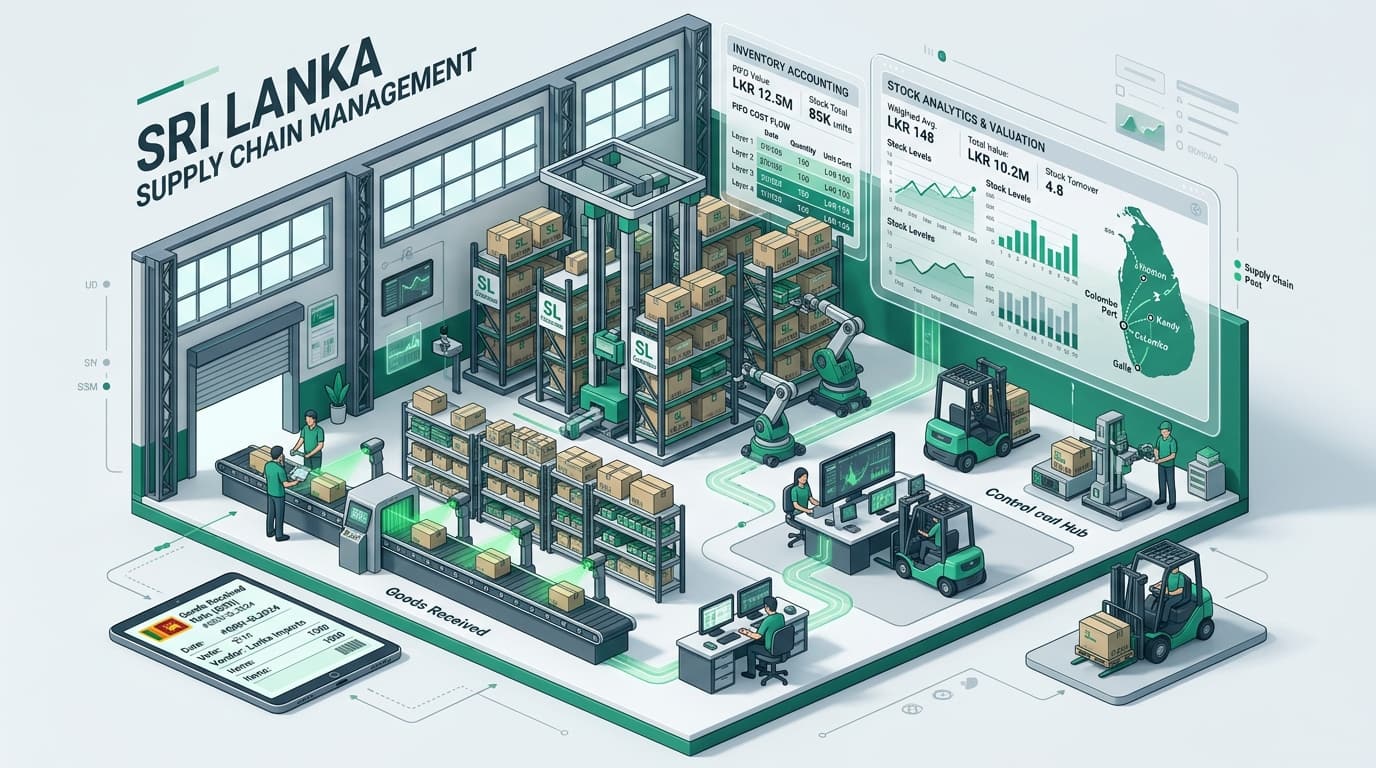
Sri Lanka Warehouse Inventory Management, Stock Valuation & Supply Chain Ledger
For trading companies, FMCG distributors, manufacturers, construction suppliers, and retail enterprises across Sri Lanka, inventory is typically the single largest asset on the balance sheet. Yet, many businesses manage stock through physical bin cards or standalone warehouse spreadsheets disconnected from their financial ledger. This disconnection causes inaccurate Cost of Goods Sold (COGS) figures, unrecorded inventory shrinkages, and distorted gross profit margins that mislead business leadership and complicate tax audits.
Table of Contents (10 Sections)↓

1. The Role of Inventory Accounting in Business Profitability

Inventory accounting is the financial discipline of tracking inventory valuation across all stages—from procurement and landed cost capitalization to warehouse storage and eventual cost realization upon customer delivery.

A properly structured inventory accounting system provides three fundamental operational advantages:

Accurate Gross Margin Calculation: Matches the exact cost of inventory consumed with the corresponding sales revenue in the same accounting period, preventing premature profit recognition.
Working Capital Optimization: Highlights slow-moving, obsolete, or over-stocked items, freeing up cash tied up in warehouse shelves.
Theft & Shrinkage Prevention: Compares theoretical stock balances against physical stock takes to detect warehouse pilferage or damage immediately.

2. LKAS 2 (Inventories) Regulatory Framework in Sri Lanka

Under Sri Lanka Accounting Standard LKAS 2 (Inventories), inventory must be measured at the lower of cost and net realizable value (NRV):

Elements of Cost: Must include purchase price, import duties (Customs duty, PAL, CESS), non-recoverable taxes, transport, handling costs, and other costs directly attributable to the acquisition of finished goods, materials, and services.
Exclusion of Trade Discounts: Trade discounts, rebates, and settlement concessions must be deducted when determining purchase cost.
Net Realizable Value (NRV): The estimated selling price in the ordinary course of business, less the estimated costs of completion and the estimated costs necessary to make the sale. If market selling prices fall below book cost (due to obsolescence or market downturns), the inventory must be written down to NRV with an immediate expense charge to the P&L.

3. Periodic vs. Perpetual Inventory Systems Explained

Businesses generally track stock using one of two accounting architectures:

Periodic Inventory System: Inventory is updated only at the end of an accounting period (month or year) following a physical stock take. COGS is calculated as: Beginning Inventory + Purchases - Ending Inventory. This method fails to pinpoint stock shrinkage or intra-month cost fluctuations.
Perpetual Inventory System: Continuously updates inventory balances and Cost of Goods Sold with every purchase, sales invoice, return, and stock transfer.
Revenue Entry on Sale: Debit Accounts Receivable / Cash, Credit Sales Revenue.
Cost Entry on Sale: Debit Cost of Goods Sold (COGS), Credit Inventory Asset Account.

Modern cloud platforms like SyncBooks operate on a perpetual basis, providing real-time gross margin analytics with every invoice issued.

4. FIFO vs. Weighted Average Costing (WAC) in Sri Lanka

LKAS 2 permits two primary cost formulas for valuing inventory:

FIFO (First-In, First-Out): Assumes the oldest inventory items purchased are sold first. In an inflationary environment with rising import prices, FIFO assigns older (cheaper) costs to COGS, resulting in higher reported gross profits and higher ending inventory valuation.
Weighted Average Costing (WAC): Recalculates the unit cost of each item every time a new purchase shipment is received: Average Unit Cost = Total Cost of Available Stock / Total Units on Hand. WAC smooths out short-term price volatility caused by currency fluctuations or freight rate spikes.

LKAS 2 strictly prohibits the LIFO (Last-In, First-Out) method.

5. Accounting for Landed Costs & Import Shipments

For Sri Lankan importers and distributors, the purchase price on an overseas supplier's commercial invoice represents only a fraction of the true inventory cost.

To comply with LKAS 2, all associated import expenses must be capitalized into item unit costs:

Import Taxes & Levies: Customs Import Duty (CID), Ports and Airports Development Levy (PAL), and CESS levy (excluding recoverable VAT).
Freight & Insurance: Ocean freight, air cargo, marine insurance, and port handling charges.
Clearing & Demurrage: Customs house agent (CHA) fees, terminal handling, and container demurrage.

SyncBooks Landed Cost Engine automatically allocates multi-currency shipping invoices across item lines based on value, weight, or volume, ensuring accurate item unit costing without manual spreadsheet formulas.

6. Goods Received Notes (GRN) & 3-Way Matching Workflow

To prevent vendor overbilling and inventory leakage, best practice enforces a strict 3-Way Matching workflow:

1. Purchase Order (PO): Authorizes the vendor to supply specified quantities at agreed prices.

2. Goods Received Note (GRN): Generated by the warehouse upon inspecting delivered stock (Debit Inventory Asset, Credit GRN Clearing Liability).

3. Vendor Bill (Invoice): Accounts payable matches the supplier bill against the GRN (Debit GRN Clearing, Debit Input VAT Receivable, Credit Accounts Payable).

This ensures your company never pays for damaged, missing, or unauthorized shipments.

7. Managing Stock Adjustments, Wastage, Spoilage & Write-Downs

In retail, manufacturing, pharmaceutical, and food industries, stock discrepancies inevitably occur due to breakage, expiration, or physical count variances:

Stock Count Variances: Unexplained physical shortages must be journalized immediately: Debit: Inventory Shrinkage Expense, Credit: Inventory Asset.
Damaged / Expired Stock: Items unfit for sale must be written off from active stock: Debit: Obsolete Stock Write-Off (P&L), Credit: Inventory Asset.
Manufacturing Spoilage: Normal production wastage is absorbed into finished goods cost, while abnormal wastage is expensed directly to the P&L.

8. Multi-Warehouse Stock Transfers & In-Transit Accounting

Growing Sri Lankan businesses operate across central distribution centers (e.g. Biyagama, Wattala, Kelaniya) and regional branches in Colombo, Kandy, Galle, and Kurunegala.

Inter-Warehouse Transfers: Transferring stock between branches must track items in an intermediate Stock In-Transit ledger until received and acknowledged by the destination branch manager.
Real-Time Visibility: Sales representatives can view available-to-promise (ATP) stock across all branch locations before committing delivery dates to customers.

9. How SyncBooks Automates Inventory & Stock Ledgers

SyncBooks unifies physical warehouse logistics with double-entry general ledger accounting:

Real-Time Perpetual Inventory: Automatically computes COGS and updates stock balances with every sales invoice and GRN.
Multi-Warehouse & Batch/Serial Tracking: Track expiration dates, batch numbers, and reorder thresholds across unlimited warehouse locations.
Landed Cost Capitalization: Distribute import shipping, customs clearing, and port duties across shipment line items effortlessly.
Syna AI Anomaly Detection: Flags unexpected stock shrinkage, warns of impending stockouts, and suggests optimal reorder quantities based on historical sales velocity.
⚡Automate Your Inventory Operations

Explore SyncBooks's Inventory workspace to manage multi-warehouse stock ledgers, landed costs, and automated COGS journalization.

10. Frequently Asked Questions

What is the difference between perpetual and periodic inventory accounting?

A periodic system calculates inventory and COGS only at the end of an accounting period following a physical count. A perpetual system updates inventory asset balances and COGS journals continuously in real time with every sales and purchase transaction.

Which inventory valuation methods are permitted under Sri Lankan accounting standards (LKAS 2)?

LKAS 2 permits the FIFO (First-In, First-Out) method and the Weighted Average Cost (WAC) formula. The LIFO (Last-In, First-Out) method is strictly prohibited.

How should import customs duties and freight be treated in inventory accounting?

All non-recoverable import duties (Customs duty, PAL, CESS), ocean freight, insurance, and port handling charges must be capitalized into the landed unit cost of the inventory items, rather than expensed immediately as operational overhead.

What is a Goods Received Note (GRN) and why is it important?

A GRN is an internal document generated by the warehouse verifying that ordered goods have been physically received, counted, and inspected. It prevents businesses from paying vendor bills for undelivered or short-supplied stock.

What happens when inventory is damaged or market prices drop below cost?

Under the LKAS 2 Lower of Cost and Net Realizable Value (NRV) rule, if the estimated net selling price drops below book value, the inventory must be written down to NRV with an immediate write-off charge to the P&L.

How does SyncBooks assist with inventory accounting?

SyncBooks provides automated perpetual inventory tracking, multi-currency landed cost allocation, batch/serial number management, automated COGS journal generation, and Syna AI reorder analytics.

📌Key Takeaway & Summary

Inventory accounting is essential for maintaining true profitability, preventing warehouse shrinkage, and complying with Sri Lankan accounting standards (LKAS 2). By implementing SyncBooks's integrated perpetual stock ledger and landed cost engine, finance teams achieve total visibility over stock valuation and gross margins.

SB
SyncBooks Editorial Team
Accounting & Tax Compliance Research

Published by the SyncBooks Knowledge & Research Team — Sri Lanka Accounting Cloud.