
Table of Contents (10 Sections)↓
1. Legal Standing of a Tax Invoice Under the Sri Lanka VAT Act
In commercial trade, businesses frequently encounter proforma invoices, commercial bills, delivery orders, and receipts. However, from a statutory standpoint, only an official Tax Invoice possesses legal standing under the Value Added Tax Act.
A Tax Invoice serves two indispensable functions:
Without an authentic, compliant Tax Invoice, any input VAT claimed by a buyer will be disallowed during an IRD audit, triggering back taxes, penalties, and interest.
2. Who Is Authorized to Issue a Tax Invoice?
Only businesses that have completed formal registration with the Inland Revenue Department and hold a valid VAT Registration Number are legally permitted to issue Tax Invoices.
3. The 8 Mandatory Statutory Fields Required by the IRD
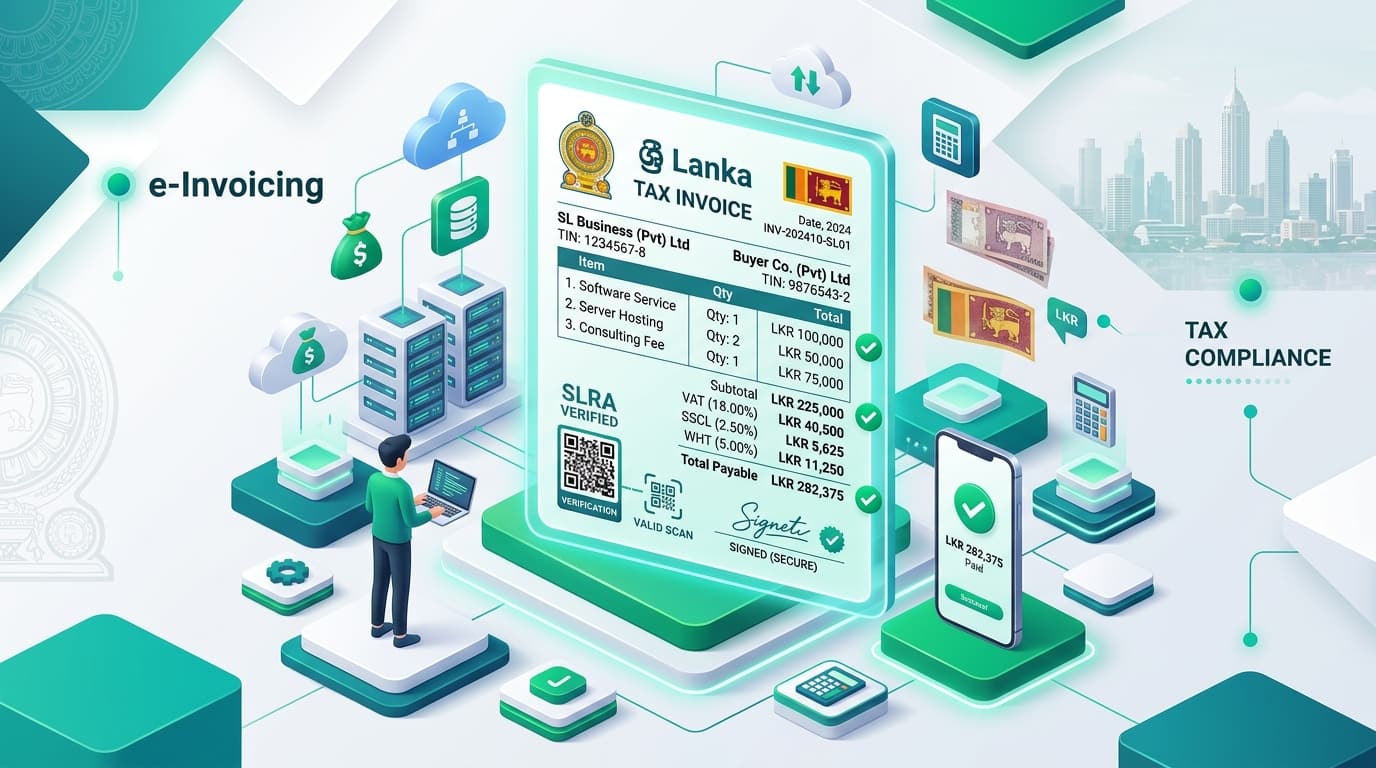
Every valid Tax Invoice issued in Sri Lanka must visibly display the following 8 components:
1. Title: The prominent heading 'TAX INVOICE' clearly displayed at the top of the document.
2. Supplier Identity: Supplier's registered business name, physical operating address, and Business Registration (BR) number.
3. Supplier Tax Numbers: Supplier's Taxpayer Identification Number (TIN) and active VAT Registration Number.
4. Serial Identifier: A unique, sequential serial number generated from an unbroken numerical sequence.
5. Date of Issue: The exact calendar date on which the invoice is generated and supplied.
6. Recipient Information: Customer's legal name, physical address, and Customer TIN (mandatory for all B2B transactions where input credit is claimed).
7. Itemized Goods/Services Breakdown: Clear description of goods/services, unit quantities, price per unit, subtotal, and an explicit separate line displaying the VAT amount charged (18%) and SSCL (if applicable).
8. Total Valuation: The total payable amount stated in both clear numerical figures and formal words.
4. Rules for Suspended Tax Invoices Under the SVAT Scheme
When supplying goods or services to registered exporters or qualified manufacturers registered under the Simplified VAT (SVAT) scheme:
5. Credit Notes & Debit Notes Statutory Regulations
When goods are returned, discounts are granted post-sale, or billing errors occur, businesses cannot simply delete or alter an existing Tax Invoice. The IRD prescribes strict rules under Section 21:
6. Electronic Invoicing (e-Invoicing) & Computer-Generated Invoices
The Inland Revenue Department recognizes computer-generated tax invoices and PDF electronic invoices provided they meet audit standards:
7. Multi-Currency & Export Invoice Compliance
For Sri Lankan companies dealing with international clients or operating in Board of Investment (BOI) zones:
8. Penalties for Issuing Non-Compliant or Fraudulent Invoices
Failure to satisfy IRD tax invoicing standards carries serious financial and legal ramifications:
9. Generating Compliant Invoices with SyncBooks
SyncBooks eliminates the compliance risks and manual errors associated with manual billing:
Discover how SyncBooks's Sales workspace generates IRD-compliant tax invoices, manages debtor aging, and automates PDF delivery.
10. Frequently Asked Questions
Is a customer TIN mandatory on every tax invoice?
For B2B transactions where the customer intends to claim Input Tax Credit, the customer's TIN is strictly mandatory. For retail consumers (B2C), invoices may be issued without a buyer TIN unless requested.
Can I edit a tax invoice after it has been finalized?
No. Under IRD guidelines and accounting standards, finalized tax invoices cannot be altered or deleted. If an error occurs or goods are returned, you must issue a formal Tax Credit Note or Debit Note referencing the original invoice.
What is the difference between a Tax Invoice and a Suspended Tax Invoice?
A Tax Invoice charges standard 18% VAT collected in cash. A Suspended Tax Invoice is issued to SVAT-registered buyers (RIPs) where VAT is suspended against an official SVAT voucher without cash collection.
Do tax invoices need to display the amount in words?
Yes. IRD statutory invoice rules require the total invoice amount to be clearly expressed in both numerical figures and formal words to prevent alteration.
Can we send digital PDF tax invoices via email to clients?
Yes. Electronic PDF invoices are legally valid in Sri Lanka provided they are generated by a reliable computerized system that maintains sequential integrity and audit records.
How long must a business preserve copies of issued tax invoices?
Under Section 56 of the VAT Act, all tax invoices, credit notes, debit notes, and supporting commercial records must be preserved for at least 5 years from the end of the relevant tax year.
📌Key Takeaway & Summary
Issuing compliant Tax Invoices is fundamental to commercial credibility and statutory compliance in Sri Lanka. By deploying specialized cloud invoicing software like SyncBooks, businesses ensure 100% adherence to IRD regulations, protect their clients' tax credits, and eliminate manual billing errors.
Published by the SyncBooks Knowledge & Research Team — Sri Lanka Accounting Cloud.